Tuesday, 15 June 2010

Lozells Get Involved Day, Saturday 12 June 2010


Last Saturday 12 June, I missed the Climate Change Festival in order to run a stall at The Get Involved Day in St Georges Park, Willis Street, Lozells. This is a sizeable open space in the heart of Lozells. Having had a history of misuse, the purpose of the day was to enable local residents to take ownership of this space and judging by the crowds who turned up, it was a great success.
I was housed with other voluntary and statutory organisations in a long marquee. There were representatives from the NHS, housing associations, the police, fire service and others, including some local businesses. Some fun things, a bouncy castle, face painting as well as a football competition. I was delighted when us stallholders were given food vouchers, that was me sorted with some delicious rice, samosas and other lovely specialities.
I gave away about thirty newsletters and a sizeable number of leaflets. These seemed to be most popular with children, who are a good way of getting an environmental message across, the colourful fold out leaflets we have on subjects such as Climate Change, Farming, Transport, appeal and they can be used to decorate their bedroom walls.
I got into conversation with a few people, always friendly, occasionally enjoyably challenging. Often people just enjoy a good argument and it isn't that they disagree with you so much as they want to be convinced themselves that your arguments stand up.

I'm making good contacts with people in Lozells which is what outreach work should be all about! For example, I'll be helping and encouraging a team of street champions which is a great chance to introduce Friends of the Earth, let people know about our work and campaigns. Its also about building on the succeses of Lozells, for example a small parcel of land called Carpenters Corner off Lozells Road has been transformed into a little green space which can be used by anyone (left). Recently its been the site of an arts installation. I'm working with Gillian Lloyd, neighborhood Manager, to start a grow site on land identified as ideal for this purpose. This will be used as a pilot project to learn from before two more, much larger sites, are created.
Theres a real buzz about Lozells at the moment, local people meeting challenges in an area which a few years ago had a very poor reputation. Theres an exciting media project run by a local school with an eco slant, check them out here, they have a jolly impressive website and make youtube videos of things happening in the local area such as a community garden planted at Anglesey Road school.
So theres loads of really inspiring and encouraging things happening.
Lozells Road has a great variety of independent stores including a proper old fashioned hardware store, a Lebanese patisserie where, for a moment, I thought I'd been transported to Lyon, never mind Lozells. Theres a tailor, clothes shops, hairdressers, several pharmacies and stores serving diasporic communities. You'll find the African grocers proudly flying Ghana's flag, a couple of Bangladeshi supermarkets with a fantastic array of fresh fruit and veg. Turn a corner and out pops a little park with a childrens play area, regularly enjoyed, well cared for and owned by the local community.
If you've been scared away from Lozells by lurid tales of gangs, guns and ganja, go and take a second look. Have a wander around what I think is an area with real character and potential.

Thursday, 10 June 2010

Birmingham Climate Change Festival 2010


Saturday the 5th of June was the first day of the three day Birmingham Climate Change Festival 2010. Centenary Square, in Birmingham, played host to the festival that offered a solar powered stage and circus, an ethical market and stalls offering information and tips on how to reduce emissions.

There were some fascinating stands and opportunities to meet people carrying out projects such as this

Birmingham Friends of the Earth were in attendance with a mini-version of the now popular monthly swap shop and an information stand. Passers by were invited to take part in a free competition offering the chance to win a home energy monitor, if they could guess the number of soy beans-not our favourite- in a jar. The estimates varied as wildly as our summer weather seems to be.


It seemed like the hottest, muggiest day we have had this year, but there was a good attendance of people passing through the festival throughout the day. Due to the efforts of everyone who volunteered, BFOE was able to highlight the importance of 'fixing the food chain', as well as other issues concerning transport and waste and recycling.


As the summer continues BFOE is always on the lookout for anybody interested in volunteering on stalls at events across the West Midlands. It is a great way to get some experience for your cv, learn something useful and have some fun! Email: joe@birminghamfoe.org.uk

(Images courtesy of Paul Tyers)

Wednesday, 9 June 2010

Elms Farm Excursion, Bank Holiday Monday 31 May

On Bank Holiday Monday 31 May a group of us from Birmingham went to Elms Farm, a biodynamic farm near Pershore, Worcestershire, as part of FOE's Fix the Food Chain campaign which forges links with local farmers.
Demeter is an organic standard dating back to the 1920s closely based upon the philosophies of Rudolf Steiner. Demeter follows a lunar calendar for planting, cultivating and harvesting with the aim of building a diverse ecosystem and becoming completely self reliant.
Elms Farm has been run since 2003 by Charbel Akiki who lives there with his wife Sussana and their four daughters. Charbel also shoulders a considerable amount of childcare while Sussana is at work in Birmingham.
I realised straight away I've met Charbel several times on his stall at Farmers Markets in Birmingham, so it was great to see from where his delicious salad leaves originate.
We began by attending Pershore's 'asparagus festival' which was a bit of a let down, I think we were too late for the asparagus, although there was some still on sale. We saw the parade through the town centre with lots of colourful floats, but I think most of us were more interested in the Farmers' Market. Like most of them in the UK, however, takeaway food and jars of preserves predominated.
Having scored our asparagus and, in Nigel's case, some serious quantities of seriously chocolaty cheesecake, we headed in the direction of the delightfully named North Piddle and Elms Farm. Many thanks to Nigel Baker, as I greatly enjoyed being chauffeured in his Toyota Prius, never having ridden in one before.
Sussana and Charbel welcomed us with a big pot of tea and we met a group from Worcester FOE who'd also come to see the farm. We soon got to know one another, chatting away and learning all about the intricacies of running a farm to Demeter standard, which is one of the most rigorous. Charbel and Sussana gave us some background on the farm, before we went on a tour.
First stop was the orchard, planted with the help of an agricultural college with some 600 fruit trees of some sixteen varieties of apples, pears, plums and cherries. Hens and Chickens were wandering around and live in a coops up in the orchard. Foxes are a serious problem, last year the farm lost around fifty birds. Cute and cuddly or a financial liability?
We then went on to look at the plantings of strawberries, three varieties; early, mid and late, the greenhouse with tomatoes, courgettes and those wonderful salad varieties planted out.
What struck me most seeing the farm is the way the crops co exist with the weeds, which grow all over the place and the sheer effort of maintaining the farm by hand. There's no tractor. It's easy to see how the price of Charbel's produce reflects the work which goes into it.
There's a beautiful meadow alongside full of tall grass and wild flowers, and Charbel described how nice it is for his children to enjoy. That's a good highpoint on which to conclude this report of our visit, and you can see some highlights on the video I made here.

Thursday, 3 June 2010

Environment Exhibition in the library

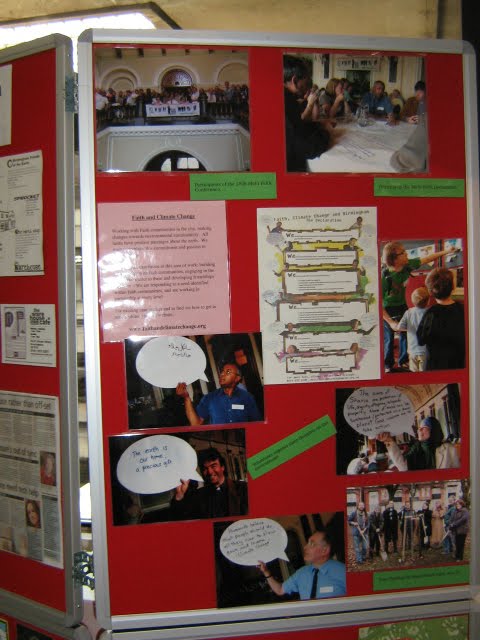
Here are some of the panels from our exhibition in the library.


Not being a very artistic person or someone blessed with a huge amount of time, when I discovered I had to put together an exhibition in the Birmingham Central Library I was slightly panicked, I have to admit. But after digging around I found we did actually have quite a decent number of good images for me to use and I laminated a few more eye-catching posters to go on there.
I think the result looks quite good and hopefully a few more people will see it and get interested in coming along to find out about what we do and get involved in environmental campaigning with us.


Please go along and check it out if you're in the library - it's on floor 5.


Joe Peacock

Wednesday, 2 June 2010

Introducing Tom Pointon Birmingham FOE's new Outreach Officer

Eleanor Hoad gets to work on the Edible Erdington project

My name's Tom Pointon and I started as Birmingham FOE’s latest Outreach Officer at Birmingham FOE at the beginning of May.

So far I've been finding out whats going on in Ladywood and Handsworth, having decided to focus my energies on these areas.

I’ve always been interested in architecture, the quality of the built environment, how to make cities enjoyable places to live. I'm keen to enable and empower people on a local level to have more influence over the quality of their environment.

Last week I was at an estate in Ladywood, meeting the Ladywood Project, which offers space for residents on an estate of tower blocks, low-rise housing, to meet, share childcare, get advice on a range of issues, have a coffee. A centre like this is invaluable for many residents in these areas and it was good to chat with the staff and learn that play areas and green spaces were being used and enjoyed by people of all ages.

Last week I interviewed two people for the forthcoming show BFOE will be launching on Rhubarb Radio, the web radio station based in the Custard Factory. Firstly I spoke to Carol Byrne, who runs LOVE, the organic and local food stall at Birmingham Central Market, and then Eleanor Hoad, who has a twelve month contract as artist in residence based in Erdington.

These two are a source of great inspiration. Carol graduated in Film and has made a number of short documentaries, mainly about the land movements in Mexico. Inheriting her market stall after her dad passed away, she's built the business into her own vision, selling a range of seasonal, local and organic fresh produce. You can hear her interview soon on Rhubarb Radio.

Eleanor Hoad’s projects show a new direction for art and culture which had me pondering ‘how do we decide what constitutes Art?’ In much contemporary art what's significant isn't the work of art, but the ideas surrounding it. This found its ultimate expression in the art scene of the nineties, with over-inflated prices paid for items like sharks in tanks, unmade beds and so on. Its through art we reflect on ourselves and our place in the universe, ability to reflect what distinguishes us from other mammals. Anything can become an art work. It doesn't need to be something tangible and physical.

In 2005 Eleanor spent twelve months touring Birmingham in a van powered by recycled cooking oil, towing a solar powered caravan. She was inspired by the way the city is continually being knocked down and rebuilt. Calling this project ‘Brave New Brum’ each area she visited was invited to nominate Seven Wonders and Seven Blunders, to get people to think about the area where they live. The entire project culminated in a treasure hunt in Kings Norton

Eleanor then ran a year long Climate Change Awareness Project in Wythenshawe, Manchester which culminated in an environmental festival bringing people's attention to climate change in innovative ways. Many local people who were involved with the festival rely on nearby Manchester airport for their livelihoods, which apparently they regard as a mixed blessing.

Through the Brave New Brum project Eleanor got to know an NHS scheme called Food Net to get people eating more healthily and working with residents of a large housing estate in Kings Norton, she had an idea she describes as ‘The Scattered Orchard.’ Kicking off on with a Valentine's day event subsidized fruit trees were offered, with 100 fruit trees planted in a day across the estate. Eleanor created a large map of tree locations. This was repeated the following year, with participants reporting on how their trees were growing. The project was so successful it was followed up by a ‘Scattered Market Garden’ where subsidized seeds were offered, a map created to record where everything was planted.

This is where imagination comes in, being key to creativity, because Eleanor was able to inspire people to plant in innovative ways, using containers on limited spaces such as window sills or balconies of tower blocks. The scattered approach is highly appropriate for urban areas. I was in London at the weekend and traveling by bus across Hackney and Islington was struck at just how much green space there is, little pockets of land all over the place. In Birmingham the low value of land could become a strength. Instead of more office blocks and industrial estates sitting empty for years we could be turning old industrial areas to productive inner city grow sites. Instead of endless schemes ‘helping people back into work’ for non existent jobs, we could work now, making ourselves more self sufficient.

Eleanor is currently running the ‘Edible Erdington’ project. Every Monday on Erdington High Street, volunteers gather to tend two planters opposite the Coop now bursting with growing vegetables. Shes also building upon her ‘Prepare’ project. Last year she went round the Erdington area identifying fruit growing in all sorts of places which were not being harvested. Apple trees in back yards, elderflowers on waste land, pear trees growing on railway sidings. Fruit trees grow in all sorts of random areas in a city, often down to food waste, discarded apple cores and suchlike. All sorts of activities spun off from this project such as an Apple festival last year at which more than fifty examples of the truly astonishing variety of English apples were on show – all, amazingly enough, harvested, foraged in Erdington!

In April a Prepare Swap Shop took place at Birmingham museum and art gallery where people swapped produce made from the fruit: jams, pickles, juices. You can catch Eleanor’s contribution to ‘In Our Backyard’ the culmination of year long residencys of four Birmingham artists. Its in the Community Gallery of the Museum (entrance on Gt Charles Queensway) and runs until 4 July.

You’ll be able to hear the full interview with Eleanor on our forthcoming Rhubarb Radio show very soon, in the meantime get down to the Museum and Art Gallery Community Gallery and see In Our Backyard.

Wednesday, 12 May 2010

Disposable nappies, reusable nappies, or infant potty training? What’s the most environmentally friendly toilet option for tinies?

My daughter was 10 weeks old when she first asked to use the toilet. I had taken her to the park in her pushchair, for an autumnal walk with my husband. Suddenly Rose shouted “a!” and started jiggling about, squirming frantically as if she had a sore behind. We rushed home and dashed to the bathroom.

To my surprise her nappy was dry. I lifted her up and, cuddling her with her back to me, supporting her legs on one arm, I held her bottom over the loo. A huge wee gushed out. She raised her little head and grinned at me. “A!” she said again. From then on, that was her signal that she needed to wee. At 16 weeks she added the word “poo” to her vocabulary. It’s still hard to believe it now. What we had accidentally discovered is called “elimination communication”. Is this the answer to the environmental problem of baby toileting?

Most parents in the developed world use disposable nappies until the child is potty trained. Disposable nappies are regarded as being environmentally unfriendly. A recent study carried out for DEFRA cast doubt on the benefits of reusable nappies as they are currently used. The study found that fewer than 5% of parents use reusables, and by far the most common reusable nappies in use are terry squares or cloth prefolds. The big impacts of reusables included the water and energy required to wash and dry them, and also, perhaps surprisingly, the energy and chemicals used to manufacture them.

As well as doubt over the environmental benefits, there are many barriers to using reusable nappies. Disposable nappies are given away at maternity hospitals. Reusables are rarely, if ever given away. Disposable nappies are available in most convenience shops, and a huge range is available in supermarkets and pharmacies. By contrast, reusable nappies are rarely available to buy from a shop.

The upfront cost is a problem. A pack of about 25 disposable nappies costs around £5. The same number of reusable nappies with wraps costs between £100 (for terry squares) to £250 for shaped ones. Once used, they become difficult to sell - for instance eBay bans sales of used nappies and many mothers feel squeamish about buying them. By contrast, opened packs of disposable nappies can be swapped or shared. It’s cheap and easy to try out a new brand of disposable nappy. Trying out a new brand of reusable requires a leap of faith, and a great deal of money.

Disposable nappies are easy and convenient to use - you put them on, take them off, throw them away. That’s all there is to it.

Reusables often require some preparation before you first put them on the baby - many require pre-washing and drying. Some manufacturers recommend washing 3, 5 or even 10 times before use. If you don’t prewash these nappies they may not absorb liquid. Some mothers who miss the pre-washing instructions give up assuming the nappy to be a poor fit. Having got the nappy into a usable condition, the reusable nappy may still require some preparation at each change. Almost all require a paper or fleece liner. Terry or muslin squares have to be folded into a shape. Babies wriggle and grab, so a flat nappy may have to be folded into shape more than once at each change.

Once used, reusable nappies have to be washed and dried. If you don’t get round to washing them, they start to stink, and you run out of nappies. If you wash them in the wrong detergent or on the wrong cycle, you can damage them, for instance by destroying the elastic or Velcro. If you dry them in a tumble drier at too high a temperature you can cause damage to the fibres, if you don’t dry them in time they can go mouldy.

It is important to note that there are types of reusable nappies that wash at low temperatures, dry on a rack within an hour or two, and are almost as convenient to use as disposables. The main difficulty with these is finding out about them, and paying the upfront cost. These were excluded from DEFRA’s study because so few people use them. It may well be that they are better for the environment than disposables, terries or prefolds. And of course, it may be possible to reduce the impacts of terries and prefolds too.

If reusable nappies are too difficult to use, and not, ultimately beneficial, then does infant potty training (elimination communication) have a role to play? Infant potty training is often used through lack of choice, in places and at times where no or few nappies of any kind are available. Using this method nappies may never be used, or their use may be discontinued as early as 9 months.

So far as I can make out, infant potty training in the UK is extremely rare. Anecdotally, some mothers who try it say they have great success. Others find it doesn’t work for them. What’s not clear, as it’s so rare as a method, is what would happen if everyone was doing it.

An interesting problem is that infant potty training does not seem to reduce the number of nappy changes and may actually increase it as the mother is more aware of each wet nappy. Where no nappies are used, if the baby is clothed then their clothes (and often their mother’s clothes) may need to be laundered just as nappies would.

For us, elimination communication worked well. We had very many clean dry days and were able to give up nappies altogether when Rose was 19 months old. But our experience of cloth nappies was so bad we used disposables. We were shocked to find out that we changed much more frequently than most other parents. In total we used as many disposable nappies as the average baby, just compressed into a shorter time.

Celia Jones

Tuesday, 11 May 2010

Park and Ride – in perspective

Superficially Park and Ride seems good as cutting off a trip by a motorist at the edge of a city and reducing pollution and traffic on residential and commercial roads, is surely a good thing. Well, for people already owning a car (and car ownership weaves a special pattern into the lifestyle), having a car park provided on the edge of town to remove aggravating city driving, is really good. But wait, here's another view:

Expecting people to drive to railway stations puts an artificial limit on the number of passengers the system can support. Car parks are expensive to build and maintain, are space-intensive, lock up valuable land near stations. The users of the system are required to own just as many cars as if public transport didn't exist. In well-patronised rail systems around the world, most train passengers arrive at the station by feeder bus or tram, not by car; it would simply be impossible to provide enough car parking to get all these passengers there by car instead.

So how does this work in practice ? Well for Network Rail's effort at attracting people to the Preston / Birmingham to London Euston trains, £89 million pounds was spent on car parking, this amounting to more than £24,000 per parking space. On the economic side, putting aside the possibility that the private car might become a scarcer resource in the future, will the parking spaces ever pay for themselves ?

Centro has built car parking spaces for railway stations, does not charge for them, and can present evidence to show that people have been attracted to the train who would not otherwise travel that way. However, there seems little trouble filling Birmingham's trains, and to invest £24,000 to attract one passenger perhaps spending £400 per year on a ticket, may not be so wise.

The parking place game diverts money from other places. It is understood that some people who would never travel on a bus, will use a train. The same people will take a taxi or go by coach during holidays, so perhaps a better bus will attract someone to travel from home without including a car in their journey at all.

Real people are the test. A parking-gift beneficiary at Selly Oak Station car park revealed her travel arrangements: Bartley Green to Selly Oak by car, Selly Oak to Birmingham by train. Easily explained as although the 20 and 21 buses are fairly close and run through to University Station (for onward train travel), they are not reliable.

An unreliable bus ? An investment of £24,000 per user could certainly buy a lot of good bus service.

(The author credits PTUA of Melbourne, Australia, with the text in bold).

John Hall